HazMat Operations vs Awareness: What Level Do You Need?
If you're a first responder trying to sort out your HazMat training requirements, you've probably run into the same question I hear at almost every department I train: what's the difference between Awareness and Operations, and which one do you actually need?
Short answer: if you will ever take action at a HazMat scene — even a defensive one — you need Operations. Awareness alone isn't enough.
The Two Levels, Plainly Explained
HazMat training for first responders is built around defined competency levels, set by OSHA 29 CFR 1910.120(q) and NFPA 472. There are two you need to know.
HazMat Awareness — the entry level. It trains you to recognize a HazMat incident, identify materials by placard and container marking, notify the right people, and take protective actions — isolate the area, deny entry, keep people back. It does not train you to take action at the scene itself.
HazMat Operations — the next level up. It trains you to take defensive action: select and don PPE, implement basic decontamination, perform defensive control actions (diking, damming, diverting, retaining), and function inside an Incident Command structure built for a HazMat scene.
NFPA 472 splits Operations into core competencies everyone at this level needs, and mission-specific competencies — PPE, mass decon, product control, detection and monitoring — that departments layer on based on their risk profile. In practice, most departments require the full mission-specific set for anyone who runs HazMat calls.
The Key Difference: Action vs. Recognition
That's the line. For most firefighters, EMS personnel, and law enforcement officers, the answer is Operations — because the job already puts you past the point of just recognizing and retreating.
What OSHA and NFPA Actually Require
1910.120(q) is clear: anyone who will take action at a HazMat incident has to be trained to at least Operations level. Awareness doesn't satisfy that for responders who take action — full stop. In fifty years in this business, that's the gap I've watched catch departments more than any other: someone did something at the scene, and the training record only covers Awareness.
Common Scenarios
Here's how this plays out on an actual call:
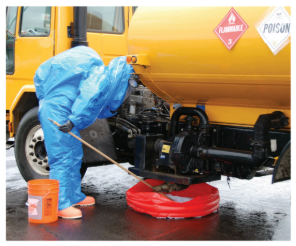
Vehicle accident, HazMat tanker involved. First-arriving units establishing a perimeter and keeping bystanders back — that's Awareness. The moment anyone sets a hot zone boundary, stages for defensive control, or preps a decon corridor before EMS moves a patient — that's Operations.
Chemical spill at an industrial facility. If your job is evacuate-and-wait-for-the-HazMat-team, Awareness covers you. If you're working the perimeter in PPE, coordinating with the facility's own response team, or making tactical calls inside ICS — you need Operations.
Patient exposed to an unknown substance. The moment EMS treats or decontaminates that patient before transport, that's direct action near a hazard. Operations, no exceptions.
Dispatch and emergency management. If you're coordinating the response — assigning units, tracking resources, running the ICS structure from the EOC or the command post — you're not in the hot zone, but you're making decisions that shape it. Most departments hold this group to Operations too, even without boots on the ground.
Why Doing Both Together Makes Sense
Operations builds directly on Awareness — they're a progression, not two separate menu items. You can't skip to Operations and have it mean anything; the recognition skills from Awareness are baked into how Operations trains you to read a scene.
Train through both and you get complete documentation from day one, no gap in your compliance record, and one training period instead of two.
SSHM delivers the knowledge base for Technician-level response — the cognitive foundation required before any hands-on Technician skills training begins. Operations is the last stop before that. If your role stops at defensive action, Operations is where your training should stop too. If you're headed toward Technician, Operations is the ground you build on.
The Bottom Line
Awareness is the foundation. Operations is the standard almost every first responder actually needs to meet. Together, they give you complete compliance documentation and the judgment to work a scene safely instead of just recognizing one.
Not sure which you're missing? Awareness ($29.99/yr) covers the foundation. Plus ($84.99/yr) — four Boosters built around PPE, decon, detection, and ICS — covers Operations-level competency. The Bundle ($99.99/yr) gets you both for less than buying them apart.
#StayStreetSmart